Letting Go of Control Truths

“Let go of control. You never had it in the first place!”

Most control freaks do not agree with the above statement. What about you? Not sure you agree? Then consider this:

“If you always do what you always did, you always get what you always got. So let go of control to get something new.”

Is micro-managing your children’s lives working for you? Or is not going too well? Here’s a suggestion:

“Listen attentively to them without “counseling” them.   It is a healing gift that allows them to process their concerns by themselves.” 

Are your high expectations of others creating distrust and dissension? If so, then try to:

“Expect Less—Control Less—and you will Discover more.”

How’s your love life been lately? Not so good? No wonder:

Love Control causes the dance of romance to lose its rhythm.”

Are your strong fears propelling you to control more even when you don’t want to?  Then you must:

“Process your fears before they become real. It greatly reduces the need to control.” 

Have your creative juices dried up? Are you looking for inspiration and need some creative nourishment?

Then (trust me) you must not,

“Overthink, overanalyze, press too much or try for perfection.” 

Is it your nature to fight, fight, fight, push, push, push, or resist, resist, resist?  What’s your stress and anxiety level? A bit high?

Here’s something to ponder:

“Surrender doesn’t mean failing; it often means winning.” 

It can be difficult for control freaks to process, but once they do, a greater freedom is available.

What it really all comes down to is this:

“To control or not? That is the question. How you answer will likely determine whether you will have greater serenity in your life—or not.”

To learn more about the habit of control freaks, click here.

In the meantime, remember to

Let it Go–and Accept “What Is!” 

Danny

*If you enjoyed this post, please “like” it on your Facebook page and share it with others.


Free Your Creative Flow by Letting Go of Control

(Excerpted in part from Losing Control, Finding Serenity: How the Need to Control Hurts Us and How to Let It Go)

If you really want to release your creative juices, try letting go of control. Don’t overthink and overanalyze, press too much, or strive for perfection with your creative endeavors. Such controlling means can severely inhibit the creative flow whether it be art, dance, writing, or composing—even cooking and gardening—because they restrict freedom of thought, of motion, and ultimately, the connection with one’s soul center.

As you begin to loosen your grip, the creative process becomes highly engrossing—even spiritual, for many—as freedom and openness of ideas and process seamlessly gel with knowledge and technique to produce original works of beauty and meaning.

In short, creativity flourishes with “opening up,” and control “closes down.” We must learn to give up creative control in order to fulfill our creative potential.
Here are four effective ways in which to let go of control in your creative endeavors.

1. Lessen Your Intensity. When you work on a creative piece or project too intensely or for too long a time, your artistic vision is easily obscured. There are things you literally can’t “see,” including the broader vision for the piece. Visual artists will tell you that when they put a work away for weeks or months and then bring it out again, they can readily note its compositional or other deficiencies. So it is important to find ways to relax and take it easy. Make yourself a nice lunch. Read an interesting article. Exercise. And don’t be so serious. In other words, just let go and have more fun.

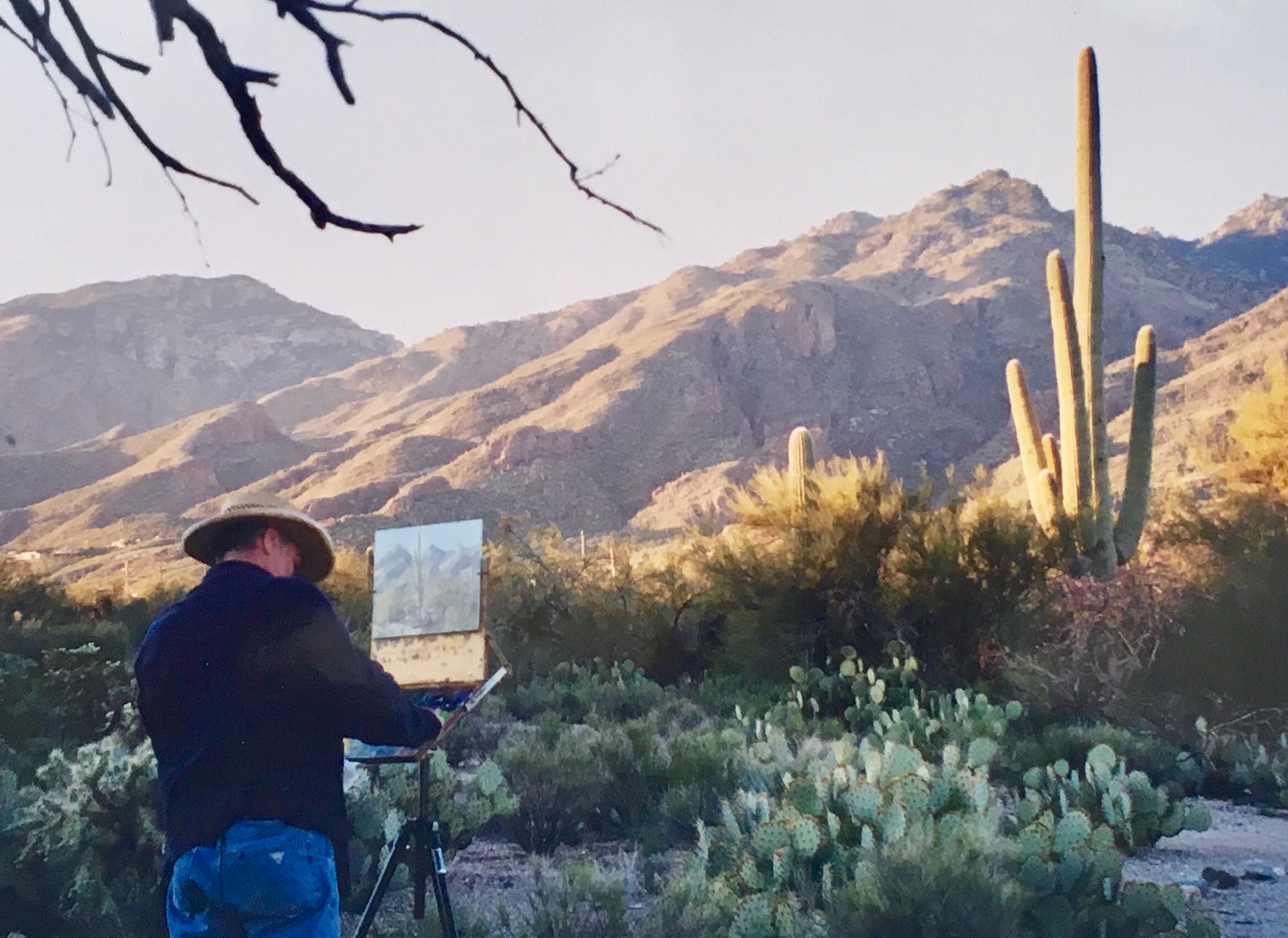
2. Diversify. Be sure to diversify creatively. Move from one creative arena to another. You will find this enhances both. I call this “creative cross-pollination.” I often go from my writing at my computer desk to my paint easel, and back again. It frees me up and stimulates fresh ideas and approaches. Hence, if you are a nonfiction writer, compose a poem. If you are stuck composing a musical piece, start another one—or better yet, try “drawing” what you imagine it would look like if it were a visual work. Do you get the idea?

3. Maintain Realistic Expectations. Overly high expectations lead to creative control. By making the “stakes” too high, you are prone to press too much or be too cautious, either of which dampens the creative flow. Things stop gelling and flowing naturally, you stop acting intuitively, and your piece suffers. As a painter, I have had many paintings that started out great, after which I raised my expectations, only to have the works falter as I pressed to maintain their high level.
Artists love to share about those wonderful “accidents” that unexpectedly occurred in a work. They will occur more frequently when you don’t set your expectations too high. Indeed, beginners often start out with a bang precisely because they had little expectations.

To practice moderating expectations, take contrarian actions. For example, start a work with the specific intention of throwing it away or not completing it. If you’ve had a masterful beginning to a work, rather than worrying whether you can maintain its high level, take a few moments to be grateful for your wonderful beginning, and then reduce your expectations for the finished piece.

4. Don’t Overthink. Thinking too much or overanalyzing about what should be done to a creative work restricts its creative flow. It makes you too cautious and afraid to take creative risks. To overcome this common tendency, place time limits on your sessions. When there is little time to plan or think, you will be more creative. Life drawing instructors, for example, sometimes allow students only 60 seconds for a short sketch—frequently with remarkable results. Thus, if you are a writer, try writing an article or short story in just 30 minutes. If you are a dancer, try to choreograph your steps in just five minutes.

Another useful technique is to start a work with absolutely no preconception for it. For example, if you play an instrument, just let the notes or keys flow. If you are a painter, indulge yourself in the physical process of moving thick paint around a canvas; or if you are a sculptor, enjoy the tactile textures of molding clay.

If you practice these “decontrol” tools, you will expand your creative horizons considerably because you will be engaging the creative currents in a more intuitive and expansive manner—and perhaps just as importantly, you will find greater joy in the creative process itself.

In the meantime,

Let It Go–and Accept “What Is!”

Danny

*If you enjoyed this post, please “like it” on your Facebook page and share it with others


Writing Love Poems by Letting Go of Control

For me, composing poems encompasses letting go of control, particularly in the sense of not overthinking and overanalyzing them.

I begin with my intention and then jot down words and phrases that evoke that intention, not really concerning myself where they may eventually fit, or whether I will even use them.

I then put these short sketches away—literally and mentally—sometimes for several months.   When I later take a fresh look at them, I usually revise and expand them.   As this process continues, I am careful not to presss for completion.  I trust that the right words and structure will be revealed in due course.

The process is very much akin to planting a seed (of thought or intention), watering it from time to time, and letting it bloom in its own time and way.

The following love poem written in celebration of my marriage to my wife, Sigute, over fifteen years ago evolved in this manner.   I hope you enjoy reading it as much as I did in writing it.*

FIRST LOVE

Not earlier loves,
Forged by expectant young hearts
And minds more lustful
Than wise.

Where changes came fast,
But few as one.
And where our child’s past
Fogged our marital screens.

Not loves where souls still searched,
And hearts still yearned.
Where vulnerable bruises
Went unheeded with loud cries.

No, I speak of a love more wise,
Between two people more whole.
One graced with clear vision
And teachings from mistakes past.

A love that honors thy self,
As much as the union.
That lightens the spirit,
And inspires the mind.

One whose pillars are trust and respect,
And mortar truth and honesty.
And whose greener grass
Lies within its fence.

Yes, I speak of a Love
Where souls dance with grace,
And where full hearts and warm bodies
Securely embrace.

This Love of which I speak
Is…Last Love.
This Love of which I speak
Is…First Love.

In the meantime, remember to,

Let It Go–and Accept “What Is!”

Danny

If you enjoyed this post, please “like” it on your Facebook page and share it with others.

*You may read more of my poems here

COPYRIGHT 2010 BY DANIEL A. MILLER
The above poem can not be copied, altered, reproduced, or published without the prior express written consent of Daniel A. Miller. However, you are free to share them with your friends with proper accreditation!  Thank you for respecting these creative rights.


Let Go of Control by Moderating Your Expectations


Many of us recognize the benefits of letting go of control and have a strong desire to do so, but struggle with it.  That’s perfectly understandable when you consider that we have been raised and have always lived in a control based world.  After all, as young children weren’t we controlled by our parents? By our teachers? And at times even by our religious leaders?  This is not to say that control is not warranted in many situations, but simply that when we have been so immersed in it throughout our lives, we feel uncomfortable and insecure without it.

It thus is a tremendous challenge to begin letting go of control—particularly with those matters and concerns that are most important to us. (Ironically, it is those areas in which losing control would be most beneficial!) As I stated in my introductory blog post, a primary reason for this blog is to provide (and engage in an intercourse about) effective tools and tips for letting go of control.  So let’s start with the first one:

Moderate Your Expectations.

High Expectations Fuel Controlling Actions

We all have expectations.  They are a natural part of our desire for a better and more content life.   We expect our friends and family to act kindly and responsibly toward us and others.  We expect our work to provide us with  certain security and benefits.  We expect our children to perform well in school; our teachers to be competent; and our leaders to govern fairly.  And so on.

The problem arises when our expectations become unrealistically high.  High expectations fuel controlling actions.  When we expect too much of people and things, it inevitably leads to disappointment followed by control actions.  When people don’t act or respond the way we want or expect them to, we try hard to change them.  We become critical, judgmental, demanding—even threatening.

High expectations impact all areas of our lives: work, family, friendships, sports, performance, to name a few key ones.  I will try to address these areas in future posts, but for now let’s consider the impact of control on our creativity.   When you have high expectations about a creative work or piece, whether it be a painting, a music composition, a script—-even cooking a gourmet meal—it induces you to over think, become anxious, and try too hard for perfection.  These types of controlling actions severely obstruct the creative process.  Things stop jelling and flowing naturally, you stop acting intuitively, and your piece suffers.  As a painter, I have had many paintings that started out great, after which I raised my expectations, only to have them falter as I pressed to maintain their high level.

Set Realistic Expectations

Consequently, you need to set realistic goals and expectations  if you wish to reduce the urge to control.  Doing so goes a long way toward saving you and those around you from undue pressure, demands, and stress.  Similarly, do not expect too much of yourself, either.  When you do, you will start pressing and forcing the action, thereby disrupting the natural flow of events.

One effective way to set realistic expectations is simply to ask yourself whether your perceived need or desire is that important in the overall scheme of things.  Most of the time it is not. It is also helpful to keep reminding ourselves that life (and thus people, occurrences and events) is constantly moving, shifting, and ebbing and flowing, and hence it is not wise to rely too much on people acting or things turning out the way we would like.

Finding Your Hidden Treasures

I would like to close with a short passage from my forthcoming book, Losing Control, Finding Serenity:

“I carry in my wallet a wise statement from a Chinese fortune cookie I opened many years ago.  It reads, ‘You will find hidden treasures where least expected.’ Think about that for a moment.  If you expect less, you control less—and find more.  Conversely, when you expect more, you control more—and find less.”

In the meantime,

Let It Go–and Accept “What Is!”

Danny

*If you enjoyed this post, please “like” it on your Facebook page and share it with others.